
Vans are one of the best canvases in the wrap world. The large flat panels on a Transit, Sprinter, or NV give a designer and installer more working surface than almost any other vehicle class, and that space translates directly into visual impact at highway speeds, in parking lots, and stopped at traffic lights where pedestrians and drivers have time to actually read what is on the side of the vehicle. Whether the van is a work vehicle, a personal daily driver, or a fleet asset, what it wears communicates something about the person or business behind it.
The ten ideas below cover the full range of what is possible, from clean personal color changes to high-impact commercial builds. Some are most appropriate for business owners who want their fleet working harder. Others are for owners who want a van that does not look like every other white work vehicle in a parking lot. All of them are achievable with premium cast vinyl installed by a shop that knows what they are doing. See the full finish range available on the wrap colors page, and completed van work in the gallery.
1. Matte Black or Satin Black Full Wrap
The murdered-out van is one of the most consistently requested looks in the shop. A Ford Transit or Sprinter wrapped in full matte black or satin black becomes a completely different vehicle from the factory white it came from. The large flat panels on a cargo van are the ideal surface for these finishes because there is no body line complexity to interrupt the tonal unity of the wrap.
Matte black reads as aggressive and intentional. Satin black adds a subtle sheen that photographs differently depending on light conditions and sits between matte and gloss for surface character. Both finishes are popular across Houston’s service industry, where contractors, logistics operators, and mobile service businesses want a fleet that looks professional rather than generic. The transition from stock white to a full blacked-out wrap is one of the highest visual returns per dollar spent in the wrap market.
Carbon fiber accents added to the roof, mirror caps, and front bumper area push the look further without breaking the tonal family of the build. For vans that will be in direct Houston sun regularly, adding a ceramic coating over the wrap provides UV protection that extends the life of the matte or satin finish significantly.
2. Bold Single-Color Gloss with Chrome Delete Accents
A full gloss color change on a van makes a statement that stock factory paint cannot replicate. Deep candy red, electric blue, emerald green, pearl white, or metallic gold applied across the full surface of a large van creates a presence on the road that is immediately visible from a distance. On the large side panels of a cargo van, these colors have the visual weight of a billboard.
Chrome delete work alongside a bold color change removes every piece of factory chrome trim, replacing it with gloss black or body-matched vinyl. On a van with factory chrome grille accents, door handles, and badging, a full chrome delete produces a cohesive look where nothing competes with the primary color. The result is a vehicle that reads as intentionally designed rather than factory-configured. The full spectrum of available gloss, metallic, and specialty finishes is on the wrap colors page.
3. Two-Tone Split Wrap
Dividing a van into two distinct color zones creates visual structure that single-color wraps do not have. The large surface area of a van makes the two-tone split particularly effective because each color zone has enough area to read clearly at distance. The most common split orientation on vans runs horizontally across the waistline, with a darker color on the lower body and a lighter or complementary color on the upper body and roof.
Texture contrast works as well as color contrast on van two-tone builds. Matte white upper body meeting gloss black lower panels creates a split that reads differently in different lighting conditions. Metallic silver meeting flat gray adds depth without introducing a second color family. The transition line, often finished with a thin accent stripe in red or a contrasting color, is the design element that determines whether the split looks deliberate or abrupt. A clean accent stripe at the waistline makes the division look engineered rather than arbitrary.
4. Full Commercial Brand Wrap
A van that is used for business and is not wrapped is an advertising opportunity that is not being taken. Every mile the vehicle travels, every parking spot it occupies, every job site it sits in front of is a visibility event. A full commercial brand wrap converts that passive presence into active marketing. The van’s panels become a mobile billboard that reaches a local audience at no additional cost per impression once the wrap is installed.
The most effective commercial van wraps balance visual impact with information hierarchy. The company name and primary service description are the largest design elements, legible at highway speed and at a distance. Contact information and website are secondary, positioned for readability when the vehicle is parked or moving slowly. The brand’s color palette is used consistently across the full surface, so the vehicle is immediately recognizable as part of a fleet even before the name is read.
For businesses with multiple vehicles, consistent wraps across the fleet amplify the professional impression. A plumber with five matching wrapped vans in a neighborhood reads as an established operation. Five white vans with magnetic door signs read as five separate contractors. The commercial wraps service covers fleet builds of any size, from single-vehicle operators to multi-truck fleets serving the Greater Houston area.
5. Color-Shift Chameleon Wrap
Color-shift film on a van delivers an effect that no other finish can produce. The film uses metallic flake technology that shifts the vehicle’s apparent color depending on viewing angle and light conditions. A van that appears deep teal from the front shifts to purple from the side and reads as green-gold at the rear. Under Houston’s direct sun, the effect is more dramatic than in any other lighting environment.
The large flat side panels of a cargo van are ideal for color-shift film because the consistent surface angle means the shift effect is visible across the entire panel at once. On a car with complex body lines, the shift can fragment across different angle zones of the panel. On a van, the viewer sees a single large field of color that appears to animate as the vehicle moves or as the viewer’s position changes. This makes color-shift vans among the most consistently attention-getting builds in the Houston market.
Installation of color-shift film requires precise directional consistency across every panel so the metallic flake is oriented the same way throughout the vehicle. This is skilled work. A color-shift build done correctly is one of the most impressive finishes available. Done with misaligned panel orientation, the inconsistency is immediately visible across the surface.
6. Gradient Color Fade
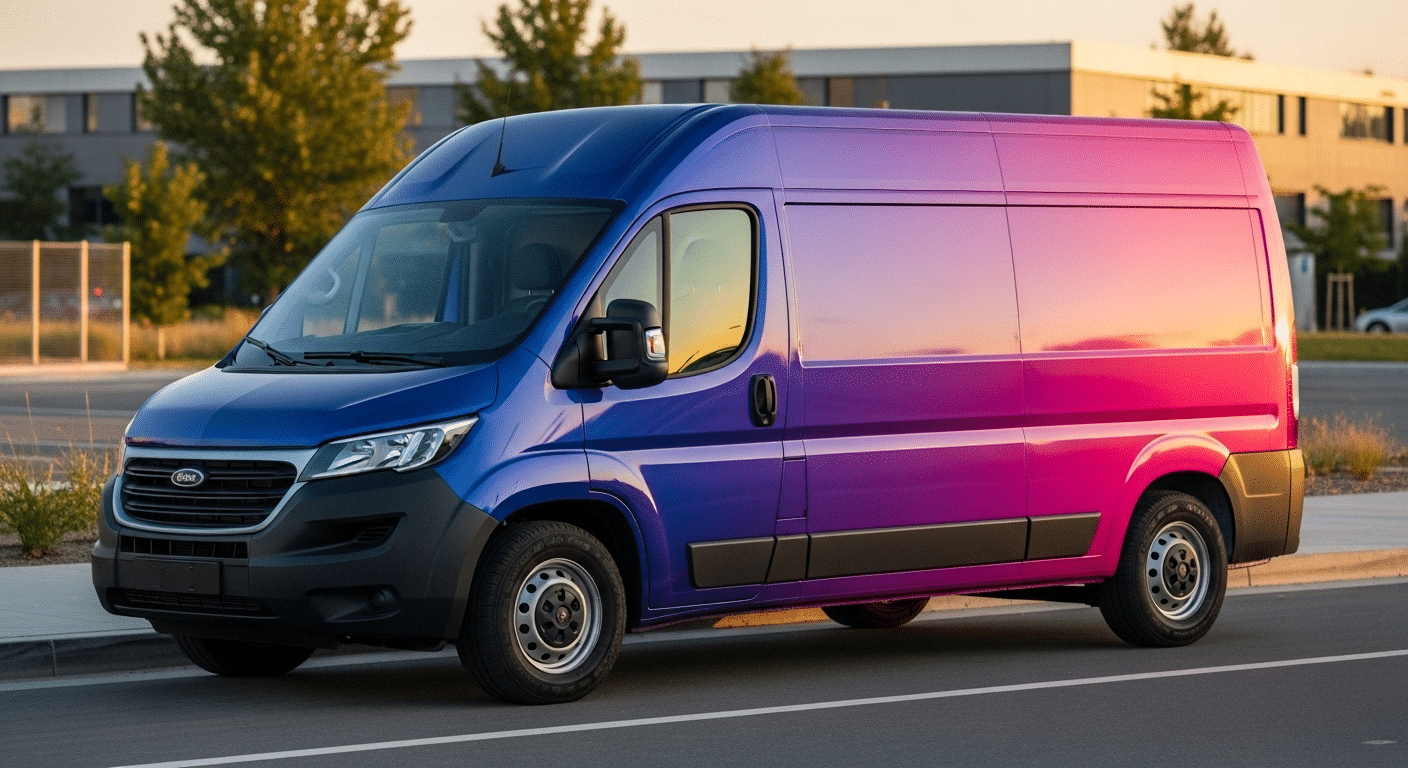
A gradient wrap blends two or three colors across the van’s surface in a seamless transition. On a full-size van, the canvas is large enough to show the gradient progression clearly, from one color at the front of the vehicle to a different color at the rear, or from a darker shade at the bottom of the panels transitioning to a lighter tone at the roof.
This approach reads as artistic and premium in ways that a solid color change does not. It also photographs exceptionally well, which matters for businesses whose vans appear in marketing materials, social media, and client-facing content. A food business, creative agency, or entertainment company whose van carries a well-executed gradient wrap generates visual content every time the vehicle is in a photo or video frame.
Popular gradient directions in the Houston market include black-to-red for service businesses that want an aggressive performance aesthetic, navy-to-electric blue for technology and logistics operations, and warm amber-to-white sunrise gradients for hospitality and lifestyle brands. Custom gradient directions are achievable in any color combination with premium digitally printed cast vinyl.
7. Photorealistic Full-Panel Graphic Wrap
Custom printed wraps remove all limits on what can appear on the surface of a van. Photography, illustration, commissioned artwork, abstract digital design, and any custom graphic that can be produced digitally can be scaled and printed to cover a full cargo van’s exterior. The van becomes a canvas in a way that no other advertising medium replicates.
The most effective photorealistic van wraps use imagery that communicates the business or owner’s identity at a glance. A landscaping company whose van features a lush photorealistic garden scene communicates its craft before the text is even read. A photography studio whose van carries examples of its portfolio work turns every parking lot into a portfolio presentation. A food business whose van is wrapped with oversized product photography triggers appetite response in anyone who sees it.
For personal builds, photorealistic wraps express creative identity in ways that stock finishes never could. A van wrapped in a deep-space nebula, a Japanese woodblock wave print, or a custom mural commissioned from a local Houston artist is a build that exists nowhere else in the world. The gallery includes examples of custom print builds that demonstrate what is achievable when design quality meets installation quality.
8. Stealth Matte White or Satin White
The inverse of the murdered-out build, a full satin white or matte white wrap on a van that came from the factory in a darker color produces a clean, premium look that has strong appeal in service industries where professionalism and cleanliness are brand signals. Medical transport, luxury shuttle services, high-end delivery operations, and mobile beauty businesses all use white or near-white matte wraps to communicate a specific brand character.
The distinction between factory white and wrapped satin or matte white is significant. Factory paint has a gloss that makes commercial vans look utilitarian. Satin white vinyl has a silky, non-reflective surface that reads as intentional and premium. Matte white is flatter and softer and communicates a different aesthetic character. Both read as significantly more considered than stock paint, even in the same base color family.
Matte and satin white builds pair well with minimal branding: a single-color logo, a phone number in a complementary font, and nothing else. The restraint of the design approach communicates confidence that the vehicle is the brand, not the other way around. This is the van wrap equivalent of a well-tailored suit.
9. Geometric Pattern or Abstract Graphic Wrap
Geometric and abstract pattern wraps apply a printed design across the van’s surface that creates visual complexity and interest without the information hierarchy requirements of a commercial brand wrap. Hexagonal tessellations, diagonal stripe systems, circuit board patterns, angular color blocks, and abstract graphic art all produce builds that register as custom and intentional from a distance.
This idea works across both personal and commercial applications. A technology company whose van carries a circuit board pattern wrap communicates its industry in a visual metaphor that no text can replicate. A construction company using angular color block geometry projects precision and structure. A creative agency whose van carries an abstract art print communicates creative capability to every potential client who sees it on the road.
Geometric wraps also allow for partial coverage approaches where the pattern occupies specific zones of the van, such as the rear quarter panels, while the front and doors carry solid color or minimal branding. This reduces print coverage cost while maintaining the visual distinction that makes the vehicle memorable.
10. Adventure or Van Life Themed Wrap
The van conversion and van life market has grown substantially, and the wraps being done on converted Sprinters, Transits, and Promaster vans reflect that culture. Adventure-themed wraps use imagery and design language that signals outdoor lifestyle: mountain silhouettes, topographic map patterns, desert landscapes, forest scenes, and abstract natural textures like wood grain or stone.
These builds are most common on owner-operators who use their vans for both travel and as a personal creative or professional base. A photographer who shoots outdoor content, a musician who tours, or a tradesperson who works regional territory all have practical and identity-driven reasons to wrap their van in a design that communicates how the vehicle actually gets used.
Van life wraps also serve a functional protection purpose. A Sprinter that will be driven through varied climates and parked in outdoor conditions year-round benefits from the UV, abrasion, and debris protection that a quality wrap provides over the factory paint. Adding paint protection film to the front bumper and hood leading edge, where stone chip and road debris impact is highest, extends the build’s durability on vehicles that see significant highway and rural road mileage.
Why Vans Are One of the Best Vehicles to Wrap

The van’s geometry is what makes it such a rewarding canvas. Large flat side panels mean the installer has room to work without the tight compound curves and body line interruptions that make car wraps more technically demanding. The roof of a full-size cargo van is another large flat surface that adds to the visual impact when the wrap is photographed from above or seen from elevated positions in parking structures.
The return on investment for a commercial van wrap is also stronger than almost any other single marketing spend of similar cost. A wrapped van generates thousands of daily impressions across its service area without any recurring spend after the initial installation. For businesses in dense metro markets like the Greater Houston area, those impressions accumulate across Sugar Land, Stafford, The Woodlands, Missouri City, and every other community where the vehicle operates, building brand recognition that paid advertising channels cannot produce as efficiently.
For personal van owners, the calculation is different but equally compelling. A van wrapped in a design that reflects its owner’s identity is not merely a vehicle. It is a creative statement that is seen by thousands of people every day. The car wrap pricing page provides baseline ranges for van wrap projects at different coverage levels, from accent and partial wraps through full vehicle coverage.
Frequently Asked Questions
How much does it cost to wrap a van?
Van wrap pricing depends on vehicle size, coverage level, and material selection. Partial wraps covering the sides and rear start lower than full wraps. Full color change wraps on a full-size cargo van using premium cast vinyl are a larger investment than partial coverage. Custom printed builds with complex graphic work are priced based on design and print scope. The car wrap pricing page provides current baseline ranges, and a direct consultation will produce an accurate quote for any specific van and design direction.
How long does a van wrap last?
A full van wrap using premium cast vinyl from 3M or Avery Dennison installed by a qualified professional typically lasts five to seven years under normal use conditions. Horizontal surfaces including the roof and hood see more UV exposure and may show age earlier than vertical side panels. Vehicles that are garaged regularly and maintained with appropriate cleaning methods consistently achieve the higher end of that lifespan range.
Can I wrap just the sides of my van and leave the roof and hood stock?
Yes. Partial wraps covering only the side panels are common and practical. The sides of a cargo van are its primary advertising surface since they are what pedestrians, other drivers, and parked observers see most. A partial wrap covering the sides and rear panels delivers most of the commercial impact of a full wrap at a lower cost. The transition between wrapped and unwrapped areas is handled with clean termination lines at panel edges.
Does wrapping a van protect the paint underneath?
Yes. The vinyl film acts as a physical barrier between the factory paint and UV radiation, road debris, environmental contaminants, and minor abrasion. Vans used in work environments that expose them to more surface contact than typical passenger vehicles benefit particularly from this protection layer. When the wrap is eventually removed correctly, the paint underneath is typically in better condition than comparable exposed paint on the same vehicle.
Can a business logo and contact information be added to any of the designs listed here?
Yes, with appropriate design consideration. Some of the ten ideas above, including the full commercial brand wrap and the bold gloss single-color build, are specifically designed around commercial messaging. Others, including the color-shift and gradient builds, can accommodate business information as a design element while preserving the aesthetic character of the wrap. The key is integrating the commercial content into the design rather than adding it as an afterthought.
What is the best van wrap idea for a service business in Houston?
The full commercial brand wrap is the most efficient use of a van’s surface area for a business that needs clients to identify the vehicle and remember the company. For businesses that want visual distinction beyond standard commercial wraps, a bold single-color build with commercial lettering integrates branding into a distinctive finish. The commercial wraps section covers fleet wrap options and the design process for business applications.
About Jay The Wrap Specialist
Jay The Wrap Specialist is the Greater Houston Area’s leading vehicle wrap company, with over 4 million social media followers and more than 2 billion views built on a reputation for creative precision across every vehicle type. Serving Sugar Land, Stafford, Missouri City, Bellaire, Richmond, River Oaks, Memorial, Rosenberg, The Woodlands, Meadows Place, West University Place, and beyond, the Wrap Leaders team brings the same installation quality to every van project, whether it is a single-vehicle commercial build or a multi-truck fleet.
Ready to Wrap Your Van? Let’s Build Something That Gets Noticed.
Any of the ten ideas in this post can be built for your van. The team at Jay The Wrap Specialist will put together a design direction and quote specific to your vehicle and goals. Call (346) 245-4998 or contact us online to schedule your consultation. Jay The Wrap Specialist turns van ideas into builds that stop traffic on Houston’s roads.